
Reflections from the Indigenous Studies special interest group
The upcoming 50th annual conference of the Association for Bahá’í Studies provided an opportunity for one special interest group to reflect on its efforts over the last few years.
-
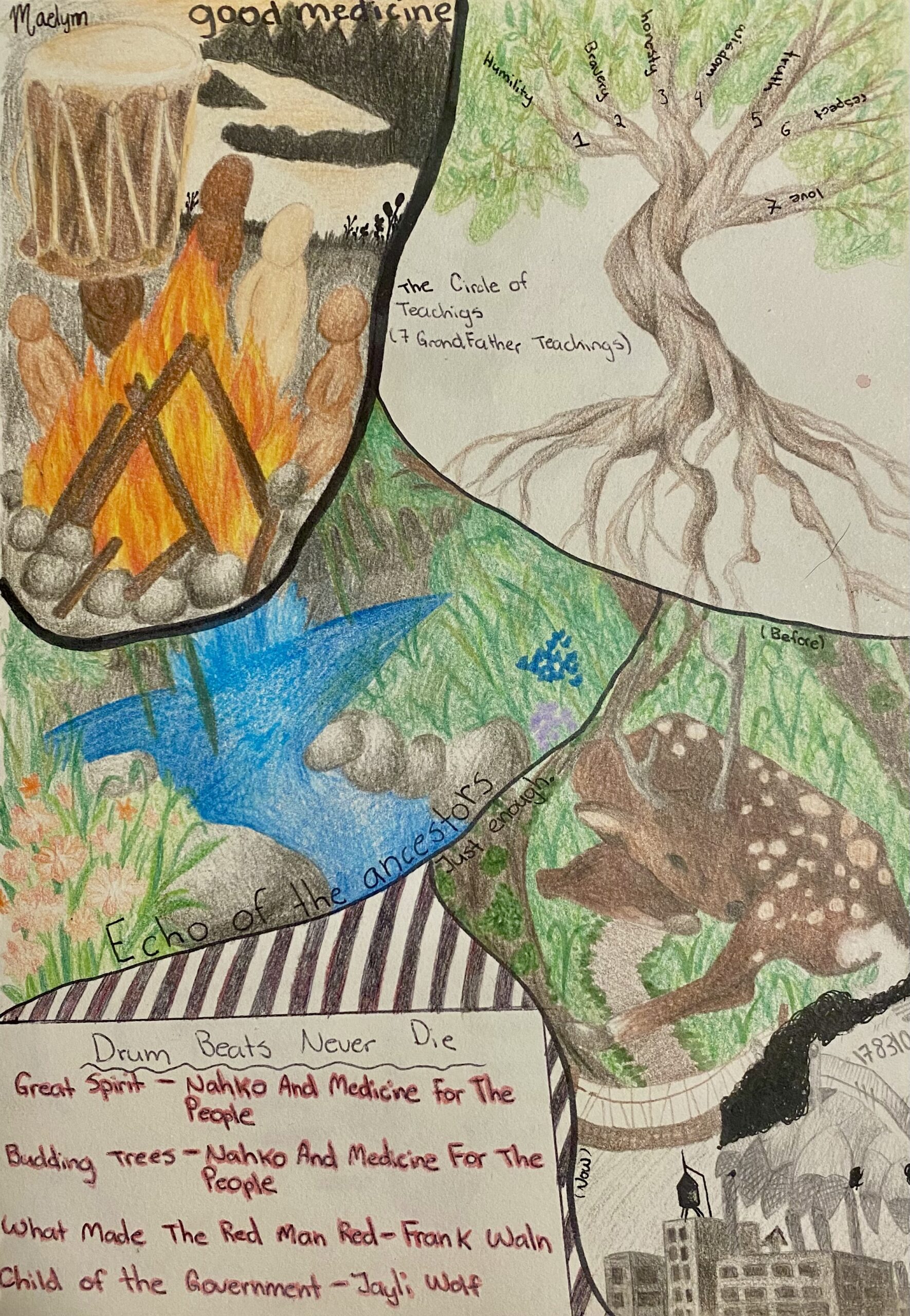
- A drawing by one of the youth participants inspired by themes explored by the special interest group. Artist: Maelynn Lévesque
Recently, the Indigenous Studies special interest group had the opportunity to reflect on what it has learned from a years-long process of collective study and consultation. These special interest groups, which often hold online sessions, are among the Association for Bahá’í Studies’ collaborative initiatives that aim to build capacity in individuals and groups to contribute to professional and academic discourse from a Bahá’í perspective.
These groups select and read texts that foster a shared understanding of a discourse and provide an entry point for analyzing its underlying assumptions using a Bahá’í conceptual framework. An important realization early in our group’s work was how little many participants knew about Indigenous Peoples in Canada today. This recognition became a starting point for genuine learning, as we realized the need for humility and for questioning our own assumptions in pursuit of knowledge.
The Indigenous Studies group brought together people from diverse professional backgrounds. Participants joined from across Canada—from Nova Scotia to British Columbia—as well as from Greenland and the United States. All were able to engage deeply with important questions about Indigenous history, cultures, spirituality, and truth and reconciliation, with an emphasis on hearing from everyone in the group.
The group has engaged with non-fiction, memoir, and fiction. Our journey has been guided by texts such as Look to the Mountain: An Ecology of Indigenous Education by Dr. Gregory Cajete; Our Story: Aboriginal Voices on Canada’s Past; Five Little Indians by Michelle Good; and One Native Life by Richard Wagamese. Stories grounded in lived experience have fostered thoughtful, compassionate conversations, helping participants move beyond “us” and “them” toward a deeper awareness of our shared humanity.
We also reflected on the importance of education for younger generations. Participants recognized that truth and reconciliation must involve helping junior youth read the reality of their communities with clarity and compassion. This led to the creation of an online, junior youth-focused reading group studying Braiding Sweetgrass for Young Adults by Robin Wall Kimmerer, adapted by Monique Gray Smith.
Throughout these conversations, the Bahá’í Writings and the guidance of the Universal House of Justice provide an essential framework. Participants are increasingly coming to understand truth and reconciliation as an ongoing process that requires collective effort across generations. This aligns with the Bahá’í Writings, which view social change as an ongoing process requiring the participation of three protagonists: the individual, the community, and institutions.
Artistic expression—whether through storytelling, poetry, visual art, filmmaking, or performance—helped participants engage more deeply with questions of memory, experience, and reconciliation. Art opened pathways to empathy and understanding that complemented intellectual discussion and enriched the process of inquiry.
From our group exploration, we identified several possibilities to consider when forming a personal action plan for reconciliation: each of us can expand our circle by attending cultural and other events in Indigenous communities, on reserves, at Friendship Centres, and in coffee shops—creativity is key here! In these spaces, with a sincere willingness to listen, we can initiate conversations and follow up on what we learn.
It is hoped that more individuals, families, and communities across Canada will consider participating in or starting similar study groups. Even small circles of friends who meet regularly to read, reflect, and consult can contribute meaningfully to greater understanding and unity. At a time when reconciliation calls for both learning and action, these spaces of shared inquiry may help us move forward together—heart to heart and mind to mind.
In the words of one Indigenous Elder participant: “Of course, the balm for our suffering is in the Writings. Sometimes, it helps to have a person’s perspective on the application of that balm. Do we need a tiny touch, or a generous application?”
Category: Uncategorized
