
Open Wide the Doors, a memoir by Mahvash Sabet
Bahá’í Canada recently sat down with Bahiyyih Nakhjavani, one of the translators of the work, to discuss the circumstances in which it was written and its themes of faith, hope and freedom.
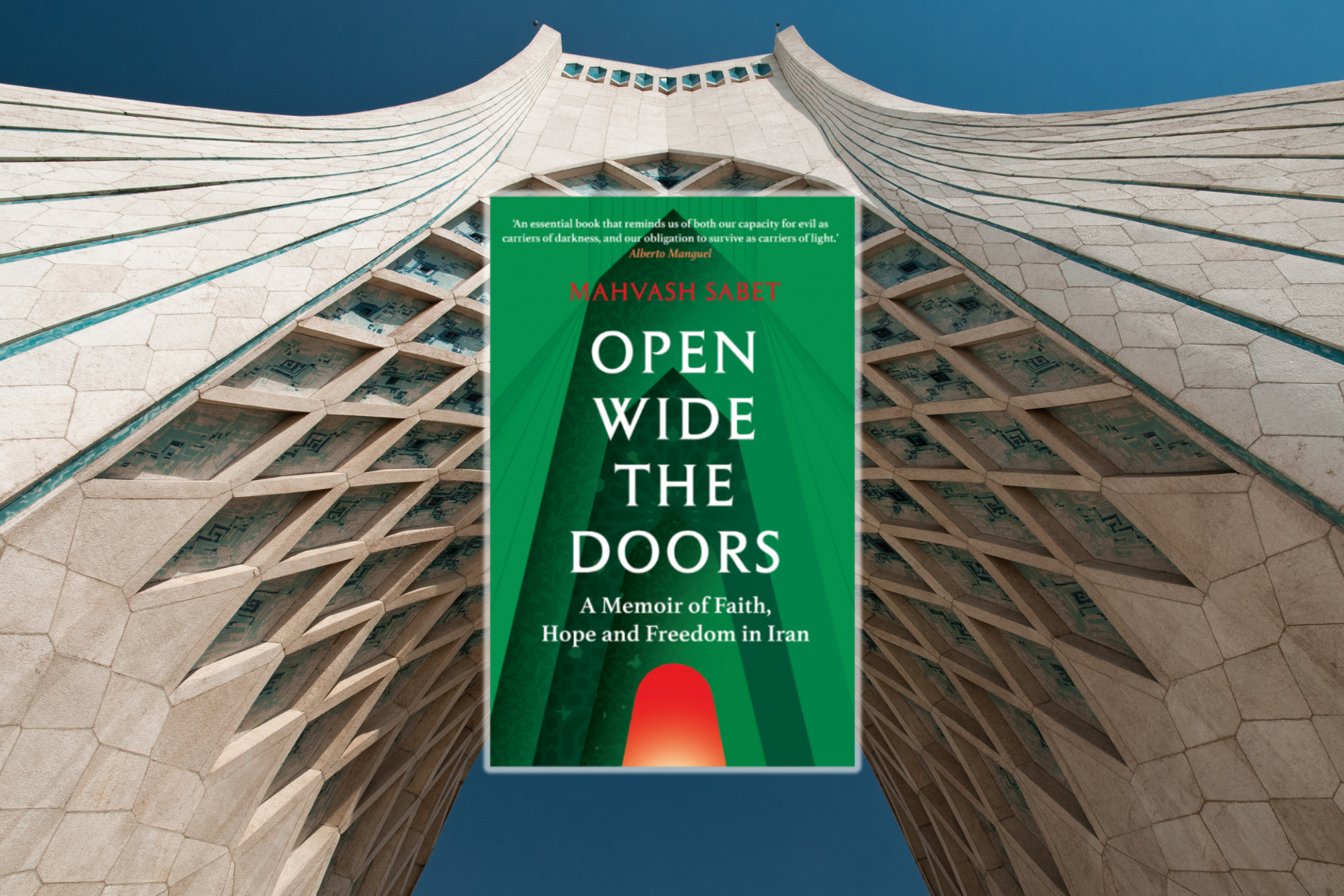
Mahvash was a member of the Yaran, an ad hoc group of seven Bahá’ís, caretakers of the persecuted Iranian Bahá’í community, who were imprisoned from 2008 to 2017. The Yaran was disbanded in 2008. Five years after their release, in 2022, Mahvash Sabet and Fariba Kamalabadi were sentenced to ten more years in prison; Afif Naimi, a third member of the disbanded Yaran, was condemned to seven. Mahvash Sabet wrote a great deal of poetry in Tehran’s Evin Prison. A first collection, smuggled out in 2011, was adapted from the original Persian by B. Nakhjavani with the help of her parents, and published as Prison Poems, by George Ronald in 2013. A second collection, A Tale of Love: More Prison Poems, followed in 2024, translated by Sandra Lynn Hutchinson and Shahin Mowzoon. In 2017, Mahvash Sabet was recognized as Writer of Courage by the Irish poet, Michael Longley, winner of the Pinter Poetry Award. Now, her memoirs, written in prison and translated and edited by A. Mottahedeh and B. Nakhjavani, are soon to be released. This book, entitled Open Wide the Doors, is published by Oneworld, in the UK, and will be available in North America from August 18, 2026.
The following interview has been edited for clarity and length.
BAHÁ’Í CANADA: Thank you so much for joining me today. It’s a privilege to get to talk about this book, which I am looking forward to reading!
BAHIYYIH NAKHJAVANI: Absolutely, thank you for having me. It is an honour to be an ambassador for Mahvash, who unfortunately cannot speak on her own behalf at this time. God willing, she will, one day, and meanwhile I hope there will be many readers who will share their thoughts after reading her wonderful book.
BC: Open Wide the Doors focuses on the first ten months of Mahvash Sabet’s imprisonment. Do you have insights about the significance of this period and why it is the focus?
BN: Mahvash was not able to write when she was first arrested. In the detention centre in Mashhad from March to May 2008, she was mostly in solitary confinement, being interrogated day after day, and the questions she was obliged to answer were all that she could write. These brutal conditions continued after she was incarcerated in Evin Prison from May to August of that same year. It was only after the upheavals of the Green Revolution in 2009, after the Yaran were finally sentenced in 2010, after Mahvash and Fariba endured almost a year in the terrible provincial prison of Rajai Shahr[1], and then the even more dreadful female penitentiary of Qarchak—only after they finally returned to Section 209 of Evin Prison in 2011, did Mahvash begin to write her memoirs.
By the time she finished and had come to the end of her 10-year sentence, she had been writing for seven full years. And by the time Azita completed a word-for-word translation of the Persian text into English, she had typed 750 pages. It’s hard to create a book that length. It’s even harder to find a publisher for such a tome. And if you try to edit 750 pages down to 200, you become a ghostwriter, which I am not. Mahvash has her own voice, and I wanted to be sure we kept it.
So that is why we focused on this initial period, about which Mahvash was able to write with a certain distance and objectivity. She is looking back over her shoulder, recalling what had happened to her three years earlier, writing in retrospect, as it were. And so she uses a real narrative style, telling the events like a story. If Azita and I chose to concentrate on this portion of her memoirs to create this book, it is quite simply because Mahvash wrote it like a story rather than a diary. Also, she was alone most of the time, so it was natural to keep a single point of view and to construct a book that followed a natural arc, beginning with her arrest, continuing through her solitary confinement, and ending when Mahvash was finally reunited with Fariba. Spoiler alert!
BC: You mentioned the story of how Mahvash finally got hold of a pen. How did she manage to write these memoirs, given the circumstances?
BN: The short answer is “slowly.” It took Mahvash seven years. Page after page she scribbled, scrap after scrap she smuggled out of prison, month after month and year after year. And in what conditions! So it is hardly surprising that it took us just as long to translate and edit her work. She asked us to prepare this book when she was free, and although we began in 2018, we only finished the actual translation in 2022. Then it took me another two years to edit and finalize the book in 2024. We weren’t in prison, but we had to imagine ourselves with her to do this work.
Imagine the circumstances in which she wrote. Imagine you’re sitting in that cell with Mahvash—a concrete box of roughly one-and-a-half by two metres, or two by three metres, depending on which ward you’re in. You’re sitting on the floor. You are squeezed in there with Fariba, and sometimes two or three other people. In the larger cells of the isolation ward of Section 209 in Evin Prison, there are two doors; this is because the wall between smaller cells (just two by four feet) was broken down when there was overcrowding. So you’re sitting opposite two peepholes in those doors. And you know very well that the guards can check on you at any time. And now you want to write. You must hide the fact that you have a pen. You must hide the fact that you have paper. Mahvash said she used to sit directly opposite the door to keep an eye on the peepholes, and wrote in such a way that it looked as if she was reading. She scribbled on tissue paper, then had to hide the tissues in her clothes, in her bedding. She sat on them, slept on them, did everything possible to keep them from being discovered. Sometimes she was able to fold them up in plastic tablecloths when the prisoners were allowed to eat with family members in the visitors’ hall. And so she managed bit by bit to smuggle 750 pages out to her husband, along with the leftovers!
BC: What can you share about Mahvash Sabet’s writing style?
BN: To write, you need three things, before even beginning to look for style: you need pen, paper and privacy. Mahvash had none of these at the beginning. Then she miraculously found a pen[2]— and although she had little privacy, she used whatever scrap of paper she had—tissues, pages of books, margins of newspapers used in the toilets—and started to write. She wrote the Prison Poems at the same time as she was writing the memoir, and it was only a decade later, when I finally read the memoir, that I fully understood what she had written in certain of her poems. Many are limpid and seemingly simple in tone; others are cryptic, enigmatic, and opaque—perhaps on purpose. But the memoir is more candid, and so many of the poems came “alive” through it.
I noticed four general styles in Mahvash’s writing. She has a colloquial voice that’s contemporary in tone, straightforward, unfussy, a modern trait in Persian literature. This style emerged in the 1960s and is the preferred style in ‘new wave’ Persian literature. But Mahvash also uses the classical Persian style. She evokes Persian poetry, uses parallel patterns that echo each other, and rhetorical contrasts in a traditional Persian manner. This style is mystical and metaphorical and often influenced by the Bahá’í writings. Her writing is also influenced by her prison experience, of course. There are many questions and answers in her memoirs that follow a distinctive interrogation style. This is even echoed in her poetry. And finally there is what I would call her pedagogic style. Remember, she was a teacher when she was free, and so her writing sometimes tends to be prescriptive.
For example, there’s a marvellous moment—heartbreaking, but also quite moving—when she’s been in solitary confinement for so long that she yearns to hear a voice, a human voice that is not shouting curses and hurling insults at her. So she starts to talk aloud. At first, she recites poems and chants all the prayers she knows. Then she starts giving imaginary classes, as if she’s speaking to an auditorium full of students. She gives them a whole commentary on the psychological effects of solitary confinement, how it effects the way you relate to your family, how it impacts your sense of time and space; and her style is cool, objective and analytic.
In the course of her 750-page memoir, she uses all these different styles at different times: the contemporary, the classic, the interrogative and the pedagogical.
-
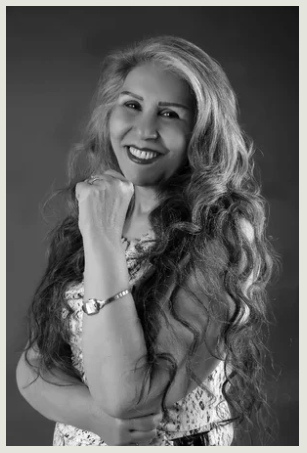
- Mahvash Sabet. Photo permission granted by Sabet’s family
BC: Quite a few women have written about Section 209 of Evin Prison, probably Iran’s most notorious ward. Can you speak about how this book relates to or provides another vantage point to this discussion?
BN: Mahvash does two things that I have never encountered in any of the other prison memoirs. And they are closely related. The first and most impressive trait of her memoir is her compassion, her empathy, her extraordinary ability to put herself in the place of others, to feel what they are feeling, to understand their dilemmas, without a trace of judgement—just with love. The other trait is that she invites the reader to do the same. She asks you to feel what she is feeling, experience what she is enduring, understand her situation. She takes you with her.
For example, when she wants to describe the prison of Evin, she starts by using that colloquial voice. “When you approach Evin,” she says, “you go through that gate, and you walk up that slope, and you turn to the right, and you see that door…” It gives you goosebumps, to be honest.
But this section was not easy to translate or edit. Readers need descriptions that make them feel they are “there,” in real time and space. And how can a prisoner be exact and visually precise wearing a blindfold? Mahvash herself often did not know where she was and had to use her other senses—sound and smell—to orient herself. It took 10 years to reconstruct the place. And yet I’ve never ever seen a description of the interior of Evin as precise as the one Mahvash has written.
Persian is a very approximate language. It hits the target on a slant, as it were. Mahvash’s description of Evin in the original was sometimes like a Piranesi sketch, with steps going up into the empty air and corridors intersecting in Mobius strip fashion. English, on the other hand, demands precision; it is a very blunt and concrete language by comparison. I needed to know whether doors were on the right or the left of corridors, whether corridors were two flights up or down the steps. And so I had to ask Mahvash many questions before I could ensure that her description was “visible” to the reader. I was lucky enough to be able to do so, because she was still free at that time.
But it wasn’t enough to give the reader only a concrete experience of entering the prison. To be true to the original, it was also necessary to capture that strange, surreal nightmare world, that Piranesi prison she describes as a prisoner in a blindfold. So the chapter on Evin is divided into two parts. The first part is when she takes you in there with her and you “see” it in real time and space. The second part is the internal prison, the psychological prison, which comes from other parts in Mahvash’s memoir where she writes on psychological isolation, on being free in prison, on the art of developing that spiritual freedom. So imprisonment that begins in horror, terror and fear, gradually evolves into a place of self-knowledge and true freedom. And Mahvash has taken you there.
-
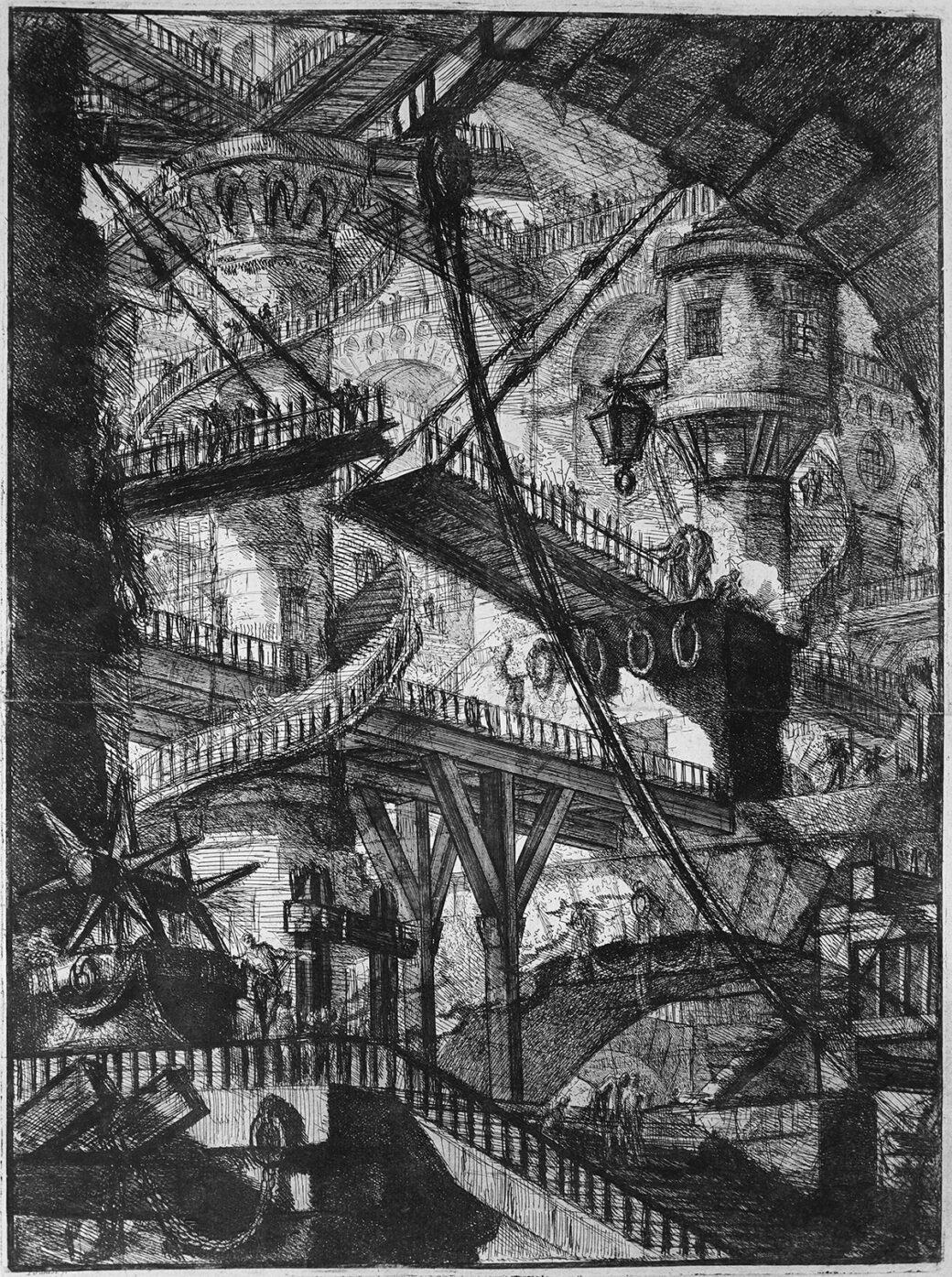
- One of a series of 16 etchings titled “Imaginary Prisons” (1761, second edition) by Giovanni Battista Piranesi. Photo: White House Historical Association.
BC: The website for the book, mahvashsabet.com, is a treasure trove, featuring excerpts. In one, Mahvash describes how she meticulously cleaned their shared cell daily, using a cloth to pick up every hair. For me, it became a metaphor for doing the good we can in the circumstances we are in. Can you shed light on the message of hope in the book?
BN: The greatest hope Mahvash offers in this book is honesty. She brings herself to account each day, each hour, and is honest with herself and with all that she witnesses and endures. Without such grounding, I don’t think hope can grow. It would be a fake flower; it wouldn’t be rooted.
Her self-scrutiny and analysis can sometimes be harrowing. She comes back to her cell after these gruelling interrogations, and asks herself, “What did I say? Was I right? Or did I say the wrong thing? Will I put somebody else in danger? Have I been true to the spirit of the Faith?” There’s a moment when the interrogator gives her pieces of paper to sign, and she suddenly notices some are blank. And she panics and thinks, “What? Is he making me sign a blank piece of paper so he can then put a false confession on it?” That is enough to plunge her into despair.
She is alone and has no one to consult. Her only recourse is to analyze herself, to do her homework, as it were, which brings us back to your hair-cleaning analogy. She realizes that she can either be a victim or take command of where she is and choose to accept it. She can either feel rage and fury, which will only increase her sense of impotence, or resolve it by deepening her faith and clinging ever more firmly to the Covenant. So she interprets her condition as a responsibility. She tells herself that she is representing the Bahá’í community, representing the Yaran of Iran. And with that role, that job to do, she keeps her dignity and sense of purpose.
These interrogations sometimes go on for 18 hours. And so, another way Mahvash maintains her inner strength is by following an outer routine, by exercising a strict discipline, like a Samurai warrior. It’s very physical. When she’s alone in her cell, she does exercises, she paces about. And when she’s in the presence of the interrogator, she keeps her back upright and very straight, her head level and her chin high. Just as she maintains physical standards of hygiene and health, she also maintains her emotional and psychological stamina. And she does this by keeping a tone of courtesy and respect when she answers the interrogator even when he is flinging insults at her. She never (except once!) raises her voice. She retains her dignity this way and can therefore avoid being objectified and victimized.
Another way that she retains hope is by a growing consciousness of spiritual support, over and above her deserving. She is literally alone for most of the time in this story and certainly suffers from the isolation, but she never feels alone. She lives in different dimensions simultaneously. On the one hand, she’s very conscious of where she is—watching the ants marching across the floor, negotiating with the cockroaches—but at the same time she’s in another dimension entirely, because of her love for others and her faith, because of her acute awareness of the impact of her imprisonment on her family and the Bahá’í community. When she has to endure horrors and manages not to break down, she realizes that she is not alone after all. She is not the only one beseeching aid from the Almighty: the whole Bahá’í world is resonating with prayers for the Yaran!
Finally, she keeps hope and faith through her humour. Oh, Mahvash has such a wicked sense of humour, such a wonderful command of irony! She pinches so hard it hurts sometimes. She mocks herself, even when she’s starving; she satirizes the stupidity of tyranny, even when she’s at its mercy; she even ridicules the “gentlemen of the Ministry of Intelligence” for their lack of it. As we read her story, we gradually become aware that someone in circumstances of unbearable difficulty is doing all in her power to help us cope with our own little insignificant problems. She’s the one who is free in spite of being in prison. And we’re the ones in the prison of self and self-indulgence, the prison of self-righteous entitlement and freedom, the prison of intellectual and spiritual poverty.
BC: The “Our Story is One” campaign launched by the Bahá’í International Community, which honours the ten Bahá’í women executed in Iran in 1983, highlights the shared aspirations of Bahá’ís and the people of Iran regarding freedom and equality. Is there a connection between this campaign and the book?
BN: Mahvash’s book fits perfectly into the framework of the ‘Our Story is One’ campaign. It is one of many such stories, and Mahvash is not alone in telling it. She was with Fariba Kamalabadi all through those terrible 10 years and again since her second arrest. She may have scribbled the words down, but precious Fariba’s silence can be heard throughout this story. And beyond Fariba is the growing circle of the Bahá’ís in prison, 63 more in July alone this year. And beyond the circle of Bahá’ís, there are all the other people suffering in these prisons, perfectly innocent people facing injustice all over the world. Mahvash never says, look at me. Her focus is on everyone else.
BC: Did any of these women’s stories stand out to you in particular?
BN: Well, let me start with the guards. Mahvash describes several types. Some are utterly ruthless, completely dismissive, cold, and inhuman. They leave her and the reader breathless and in shock. Others she is able to befriend, and they turn out to be compassionate and kind. One of the latter, an old woman serving in a temporary capacity in the detention centre of Mashhad, stoutly denies that she even is a guard and becomes very fond of Mahvash. So we are introduced to both extremes.
Then there are the women prisoners. Here too we encounter the extremes: those who are violent and those who are passive; those who take advantage of others, even in such cruel circumstances and those whose helplessness is heart-breaking. There’s one of the latter variety that I cannot forget; I’m quite haunted by her. She’s a young woman, and her story is heart-rending, because you can imagine it multiplied millions of times—wherever women are oppressed.
This young woman was happily married, had a child, and was pregnant with the second when her husband died. He fell from some scaffolding, and that ended her life, as well as his. A young pregnant widow with one child is a real liability in a patriarchal and fundamentalist culture. First of all, her husband’s parents claimed the children—the eldest son, and the second as soon as he was born—because according to the law they belong to the paternal side of the family. Then, stripped of her children, and still with milk in her breasts, she has to go back to live with her parents, where her father insists that she be remarried. Otherwise, it’s a shame on the family. So, he forces her to marry an old man who is anathema to her and an opium addict.
She is pushed to such limits of despair that she does a terrible thing. In an attempt to drug them and escape, she kills her family by mistake—her brother, her sister, even her father—and then burns the house down to hide the crime. But this man, her husband, survives, and now she is a murderer. The girl in a state of trauma. She doesn’t know what she’s done. She only knows that since her mother has paid the bail, she will have to go back to her abhorred husband. And she talks to Mahvash, in tears, in the middle of the night, saying that she doesn’t deserve to live. I don’t know why this story stays with me in particular; I think it is because Mahvash met several others like her, whom she describes in the rest of the memoir, and so this young woman stands out as a representative of the helpless and hopeless millions all over the world.
BC: Do you have insight into Mahvash’s hopes for this book?
Despite the fact that Mahvash is a prominent Bahá’í and has been sentenced and suffered for her faith in Bahá’u’lláh, this is not, strictly speaking, a book about the Bahá’í Faith. It’s not a book that sets out to teach the principles or describe the history of the Faith. It is quite simply a book about hope, about integrity and compassion in times of difficulty, and our longing for justice. It’s a very personal story, and at the same time one whose power is universal. Mahvash wanted this story to reach as many people as possible, whether they knew about the Bahá’í Faith or not. That was her dream. If we respond to it, that means our heart’s mirror yearns for that same light, longs for that very hope. Mahvash’s message is so important that it should reach many, many people. Whoever reads her book will surely become an ambassador for hope too, in these times of despair.
BC: How was the title of the book “Open Wide the Doors” decided on?
BN: Mahvash didn’t have a title in mind when she wrote her memoirs, but she refers to doors at least 200 times in this book. You go through this door, you come from another. Shut doors, open doors, the clanging of doors, the locking and unlocking of doors, doors with and without handles and keys. There are just non-stop doors, a labyrinth of doors in the prisons she describes.
There are also the doors inside us—shutting us behind our blind prejudices, locking us in our obstinate ignorance. When I read the wonderful passages in the book where Mahvash says, “I felt as if I was free, and everybody else was in prison,” I thought, it’s because her doors are wide open. So it seemed like a logical choice. Besides, the title has that radiant Biblical resonance of prophecy about it, and God willing, one day the doors of Iran will also be opened wide. We used a line from the poetry of Rumi to set the tone of this book: “Why stay in prison when the door’s wide open?” and chose to dedicate the book to the people of Iran, in the spirit of this same hope.
The book ‘Open Wide the Doors’ (Oneworld Publishers) is available to preorder with a release date of August 18, 2026.
[1] Also commonly known as Gohardasht Prison, in Karaj, some 20 kilometres west of the Iranian capital.
[2] This story can also be found here: https://pentransmissions.com/2023/09/20/prison-poems/
Category: Uncategorized
