
Advancing gender equality: an ongoing, generational process
Bahá’í Canada spoke with three young men about their experience putting the principle of gender equality into practice at a recent camp.

In Canada, young people can often consider the equality of women and men as a worthy yet abstract concept that does not affect them personally. This belief was challenged when a group of six youth in Sudbury, Ont.—three young women and three young men, all 21 or 22 years old, examined their own social reality.
These youth, all serving as tutors and junior youth animators in their locality, had gathered to prepare, both spiritually and practically, for an upcoming week-long overnight camp. They were thinking about how to create an environment conducive to spiritual and intellectual growth, as 38 participants aged 15-18 would soon gather to study courses from the Ruhi Institute. These camps are havens for the youth. Often, the negative social forces they wish to address in their communities are remedied here first.
Before the camp, the youth tutors, assisted by an Auxiliary Board member, studied the 19 March 2025 letter from the Universal House of Justice regarding family life and marriage. What stood out to them among the Bahá’í principles applicable to family life was the principle of the equality of women and men.
The letter states, “[C]ertain gender roles that characterized an early stage of human development could eventually impede the advancement of women and of society at another…A challenge for Bahá’í communities worldwide, then, is to examine the present practices in their societies, weigh them in light of the Teachings, weed out any undesirable tendencies, and learn to establish new patterns of family life suited to the needs of a new age.”
The youth found the concepts in the message to be very relevant to both the kind of environment they wished to create at the camp and in their greater community. The statements, “[G]irls and boys will be raised with a new understanding of equality and its practical expression. The ramifications of this principle will thus gradually extend to future generations…” were a source of inspiration in their endeavours, as the youth—both tutors and participants—serve those younger than themselves.

While studying this letter, the female tutors were encouraged to share how current social norms and practices have negatively impacted them. This frank and vulnerable conversation revealed that gender equality has not yet been achieved, which has a very real and prevalent influence on the lives of young people.
This conversation led to a leap in consciousness among the tutors, particularly the young men, Simi, Eli and Josiah. Simi said, “For me, it was very eye-opening because I knew that there was inequality against women, but it wasn’t very conscious in my mind…I thought it was something that happens in the news and not next to me.” It also gave them a sense of urgency regarding the issue.
When reading their own reality in light of this principle, the youths’ reflections focused on the social dynamics they observed. They discussed how men could be dismissive of women, backing each other up, without considering the truth. This can cause young women to minimize the issues they experience. The youth thought that there was an oversexualization of both genders, often through comments that go unchecked, with women’s worth being based on the male gaze. They also noticed that during the camps, the authority of the women tutors was not taken as seriously as that of the men, and that the women volunteered to do tasks like washing the dishes more often. There was also a realization that aggression is not only physical but can also manifest itself in language, and that the women around them had a lesser sense of safety than they did.
These assumptions and dynamics, Eli describes, “Can create cultures of men versus women, which lead to disunity. This makes it hard to consult and arrive at a spiritual truth together. It’s very difficult to enact justice. It’s difficult for each person, especially women, to feel like they’re thriving and growing when others put them down. It’s difficult to focus on the spiritual aspects of life when others are focused on your physical characteristics. These tendencies can create negative feelings in both women and men, such as anger and sadness. A spiritual environment requires joy to fulfill its potential.”
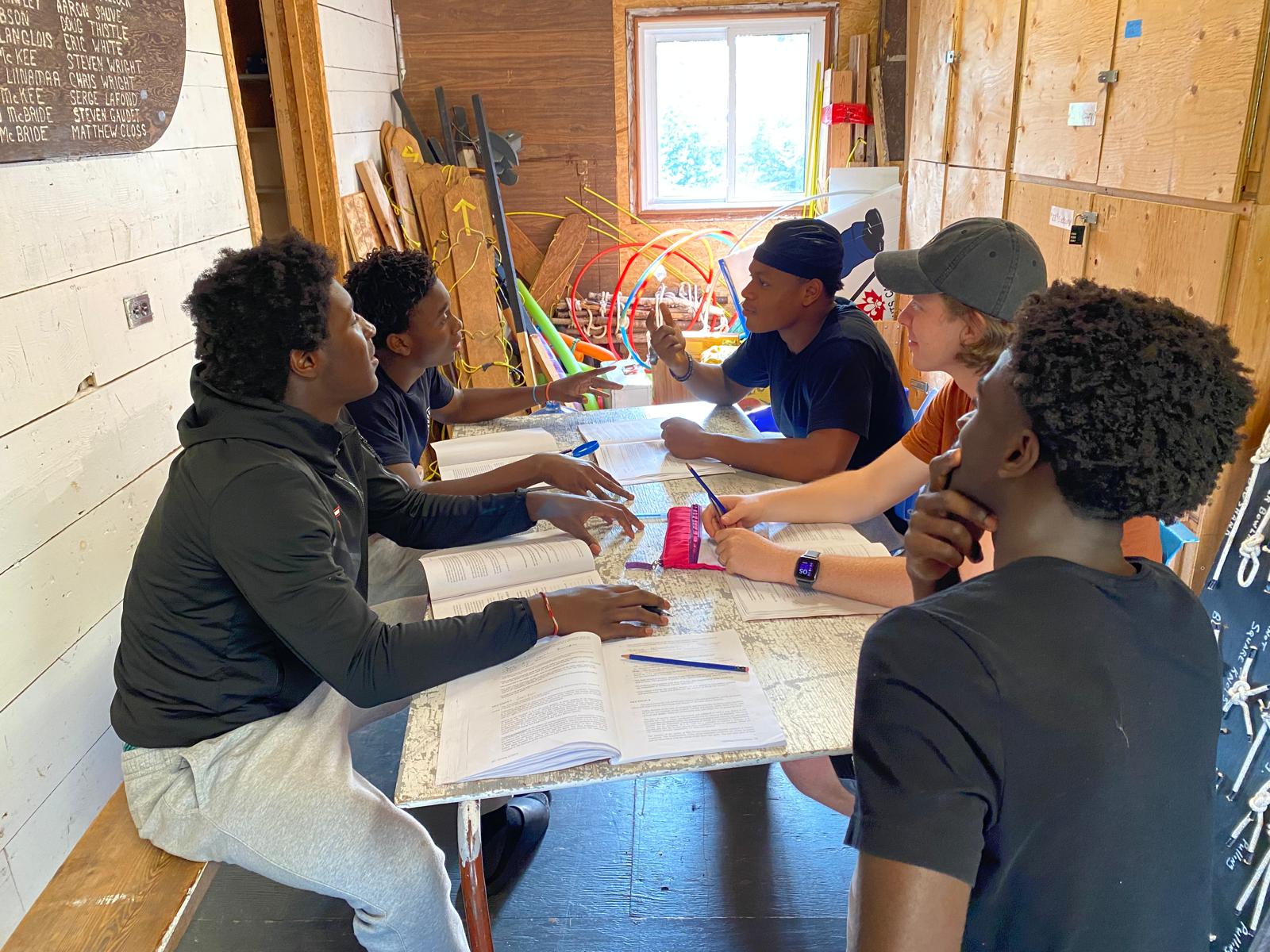
Josiah spoke about how years of consultation, action and reflection among the tutors had prepared the group to address these issues at camp. They knew how to act “as the fingers of one hand,”—a quote from Bahá’u’lláh that Josiah kept going back to when describing how the youth tutors, men and women, worked as a team, which had a “good dynamic of trust.”
The tutors made a collective agreement to address these dynamics when they came up in a spirit of loving encouragement. Eli explains, “When we hear something, we’re going to address it immediately. And sometimes that takes courage, but it’s what’s necessary for the spiritual growth of these youth.” Simi explains, “Not one person makes decisions. Everyone consulted on the spot and then made quick decisions about what could happen.”
They resisted the tendency to argue or prove a point. Eli explains, “When we are considering the spiritual growth of a population, it makes it very easy for anyone to agree that this needs to be addressed… A desire for justice and to see spiritual growth removes the self from these issues.”
“The men need to act as role models and help guide the younger men to become more aware of these issues,” Eli continues, “They can just get into arguments about these things, and arguments don’t lead to a shift in understanding.”
Eli served as the tutor of a group of four younger youth for Ruhi Book 2: Arising to Serve, a text that prepares participants to discuss spiritual principles in their daily lives. As part of their studies, they undertook a research assignment to go around the camp and ask the women about gender inequalities in society. “I was very impressed with these boys,” Eli explains, “because they actually did it, and they did it with an open mind…I think coming at it with an attitude of learning was really helpful. They collected their learnings and presented them to the camp at the end of the day.”
Simi explains, “Trying to implement the principle makes us active participants in the principle. It’s one thing to observe and see the problem and another to have conviction and act on it. Youth can tell if we have conviction.”
Category: Community life
