Fall/Winter 2025/2026 issue of Bahá’í Canada
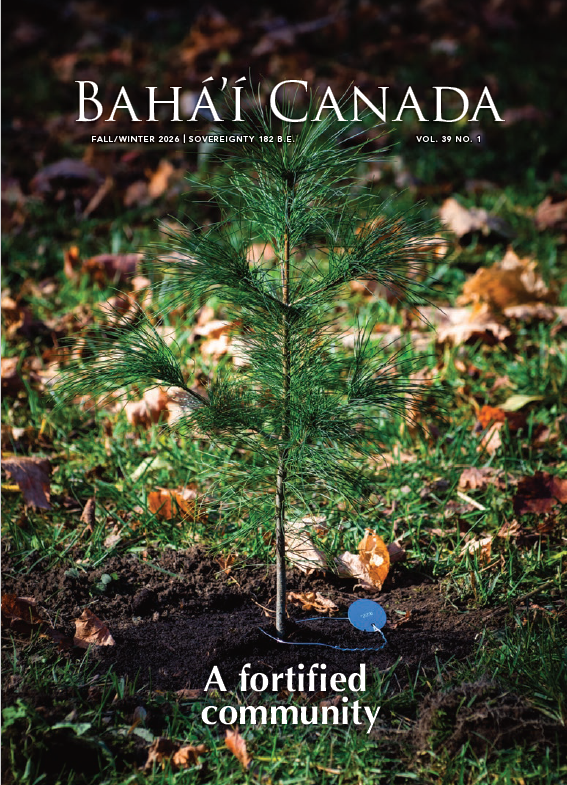
The title of this issue, “A fortified community,” comes from the House of Justice’s 30 December 2021 message to the Continental Boards of Counsellors, which states, “By the conclusion of the new series of Plans recently begun, the Bahá’í community will need to have acquired capacities that can scarcely be glimpsed at present.” The House of Justice then encourages the Counsellors to explore “what is required to bring into being such a fortified community.”
As we approach the end of the first phase of this nine year endeavour, the Canadian Bahá’í community has learned much. As the National Assembly wrote in its 25 November 2025 message, “Neighbourhood after neighbourhood is now blossoming, vibrant communities emerging from once-tiny seeds, whether a first conversation with a neighbour, a first devotional meeting, a first mothers’ gathering, or a first group of youth arising to serve their younger peers.”
A fortified community is both a protection from negative social forces and a setting infused with rich spiritual nutrients. As more individuals and communities apply the Word of God, the divine elixir, to their individual and collective lives, signs of positive transformation abound. To pray together, to refrain from backbiting, to educate children to develop a noble and upright character; these are all fortifying elements of communities.
The feature article in this issue, “Arbor Glen: Nurturing children, a community’s most precious treasure,” illustrates how such a community was formed. In this Toronto neighbourhood, a single children’s class initiated almost a decade ago has evolved into a process in which 600 people are engaged in meaningful conversations, with many emerging as protagonists in the community building process. The institute process has provided a set of coherent concepts through which family members are realizing their aspirations, overcoming challenges, and drawing closer to one another.
In the From the History section of the magazine, a book review of Paul Hanley’s ‘Adasiyyíh: The Story of ‘Abdu’ l-Bahá’s Model Farming Community, by Rhonda Gossen, also explores the theme of a fortified community. ‘Abdu’l-Bahá purchased a plot of land in Jordan that was degraded and covered in thorny brush. The community of farmers that he tasked with cultivating it undertook what is now called “regenerative agriculture,” and after extensive labour, the land yielded a variety of crops. This community became a model from which others in the region learned, and as is known, grains transported from ‘Adasiyyíh protected many in Haifa and ‘Akká from famine during World War I.
In the article “From Morocco to Canada: A path of confirmations,” Núr Elmasri describes his journey as an international pioneer, first training in Jordan before arriving at his post in Morocco, where he serves today. The article highlights how pioneering in this Nine Year Plan is a means of sharing learning generated about the educational process from one community to another, across the globe—the benefits of which are felt by both the community sending and receiving a pioneer.
Another article focuses on a recent multimedia art exhibition in Aurora, Ont. The exhibit, titled “SABZEH” (sprouts in Farsi), much like Arbor Glen, started with a seed of an idea that grew as a collective of artists joined the enterprise. They interpreted the concept of growth through sound, fibre arts, dance and visual arts. The exhibit was also inspired by the #OurStoryisOne campaign, which highlights the Bahá’í women executed in Iran solely because of their Faith.
Finally, the poem The Dawn of Unity, by Robin Kers, reflects on the Báb and Bahá’u’lláh—the two Figures Who bind the hearts of the growing worldwide Bahá’í community and Whose message gives humanity spiritual life and purpose.
Category: Magazine