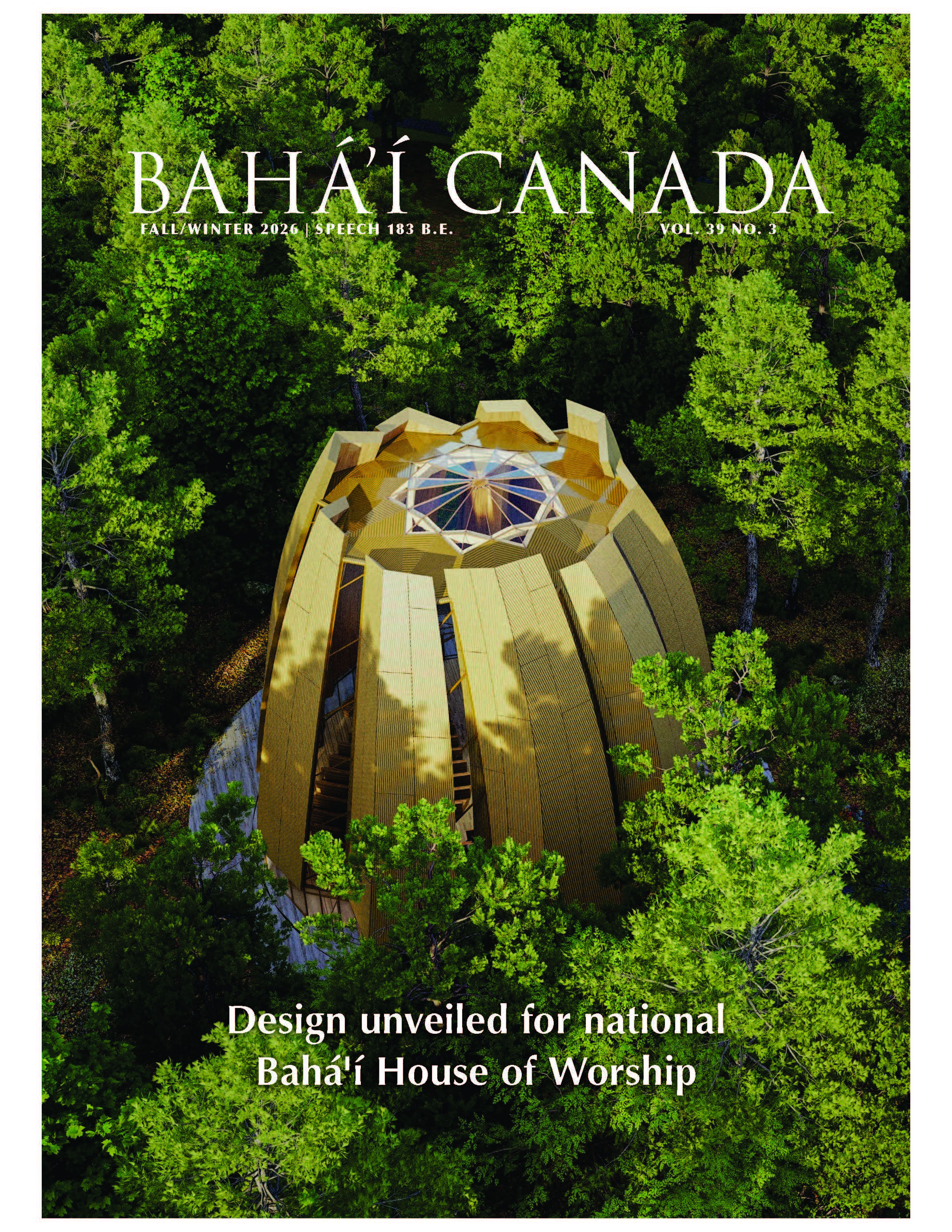
In its 8 September 2026 message, the National Spiritual Assembly wrote: “Beloved friends, how can we thank Bahá’u’lláh enough for the privilege bestowed upon our generation?”
It continues, “We have been given not only the joy of raising up Canada’s national Mashriqu’l-Adhkár but also the gift of contributing to all that it represents: worship and service woven together, communities becoming havens of peace, and the light of unity shining ever more brightly amid the gathering darkness of the world.”
This issue of Bahá’í Canada marks a milestone in this privileged undertaking: the unveiling of the design for the House of Worship for Canada. Our feature article explores the inspiration and process behind the design, introduces the project’s principal architect, James Jing Yi Jiang, and highlights key moments from the livestreamed unveiling. How joyful it was to receive photographs from friends in St. John’s, Nfld.; Grand Manan Island, N.B.; Saskatoon, Sask.; and Abbotsford and Vancouver, B.C. (among many others), who gathered for this occasion! It was truly a moment for Canada.
On the path ahead, we will no doubt encounter challenges and can call to mind those souls who were among the first to establish a Bahá’í temple. In the From the History section, we share a story about Hand of the Cause of God Corinne Knight True, known as “Mother of the Temple,” from the book *Corinne True: Faithful Handmaid of ‘Abdu’l-Bahá*, by Nathan Rutstein. For over five decades, Corinne True dedicated herself to erecting the Continental House of Worship for North America, which was completed in 1953. This story focuses on the first of these decades as she is guided by ‘Abdu’l-Bahá to take on an increasingly larger role in this enterprise.
A defining feature of the Bahá’í Temple is that its doors are open to all, regardless of religious belief or unbelief. The theme of doors resonates in the new memoir *Open Wide the Doors* by Mahvash Sabet, one of the seven members of the now-disbanded Yárán, who was imprisoned for over 10 years for her role in overseeing the spiritual and social needs of the Bahá’í community of Iran. Her doors are both physical and locked from the outside, and metaphorical, as she challenges barriers such as prejudice and ignorance. Before its release, Bahá’í Canada had the opportunity to interview one of the book's translators and editors to learn more about how the memoir came to be.
This puts into perspective the blessing we have now to build havens of peace in our communities—the other element of “one divine project.” In this issue, we share stories from summer activities that flourished across Canada, especially among the youth. These stories highlight the conversations happening at the grassroots—conversations that unlock capacity for action.
Stories about the Sacred Charge Campaign in Ontario and the youth movement in the Central Okanagan cluster in British Columbia show how youth are increasingly seeing themselves as capable of making a positive difference. As they are introduced to concepts embedded in the training institute, young people become empowered to apply spiritual concepts to every aspect of their lives.
In this issue, we also hear from the Regional Schools Coordinating Committee in British Columbia. Over the past few years, it has cultivated a system for creating spaces open to all, focused on fostering the spiritual health of families and communities. This year, five schools across the province brought together hundreds of friends of all ages to engage in the arts, pray together, and participate in a variety of educational workshops.
This issue also takes us internationally. In the story “Planting roses of love in the Leeward Islands,” a Canadian pioneer family shares how the Word of God is effecting transformation on the playground, creating unity in children's day-to-day lives.
This past May, a historic gathering was held, built on recent efforts to translate the Bahá’í Writings into Indigenous languages. The consultation among the friends gathered highlighted the spiritual aspirations of Indigenous Peoples, including the well-being of children and youth, strengthening extended families, and fostering hope for the future.
In another development, we are pleased to share that the Bahá’í Canada website ([bahaicanada@bahai.ca](https://bahaicanada@bahai.ca)) has been redesigned. We hope this redesign will further connect the print and online versions of Bahá’í Canada and better serve online readers. Going forward, nearly all articles will be published as individual stories on the website. We will then compile a collection of these stories for the print magazine. A PDF version of the print magazine will continue to be published online.
Going forward, we look forward to sharing more about how communities across the country are taking these two endeavours—cultivating a rich pattern of community life and raising up a House of Worship—into their own hands.